
Every gardener knows the struggle: you crave the ethereal beauty of Russian Sage’s lavender-blue spires, but your limited space rebels against ‘Blue Spires’‘ sprawling 3-4 foot frame. You’ve tried pruning aggressively (only to stunt flowering), experimented with sun-loving alternatives like lavender (that wilted in your clay soil), or worse – surrendered to empty gaps in your xeriscape. The compromise always leaves your garden design feeling… incomplete. Until now. Lacey Blue Russian Sage solves this spatial dilemma while delivering deer-resistant blooms from midsummer through fall – all in a compact 18-24″ package discovered in an English garden and now available to transform American landscapes.
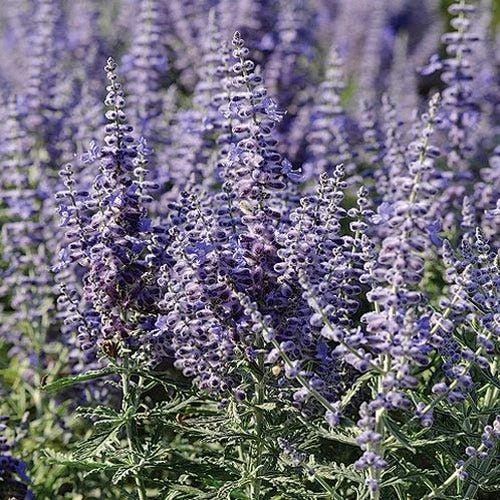
Botanical Breakthrough for Small Spaces
Perovskia atriplicifolia ‘Lacey Blue’ represents a horticultural milestone – the first true dwarf Russian Sage that maintains all the beloved traits of its taller cousins. Unlike genetic dwarfs that compromise flower size, this cultivar boasts exceptionally large flower spikes relative to its compact 24-36″ width. Thriving in USDA zones 5-9, it’s a drought-resistant solution for:
- Urban gardens with limited square footage
- Xeriscapes requiring water-wise perennials
- Border plantings needing structure without sprawl
- Fire-prone areas (firescaping approved)
Key Attributes:
Long Bloom Period
Clay Tolerant
Pollinator Friendly
The Science Behind the Beauty
Physical Structure
Unlike traditional Russian Sage varieties with their open, sometimes leggy growth habit, Lacey Blue maintains a dense, self-supporting form. The silver-gray stems branch more frequently, creating a fuller appearance without sacrificing airiness. Its smaller leaves (atriplicifolia = “with leaves like Atriplex”) contribute to the refined texture while reducing transpiration – key to its drought tolerance.
Biochemical Advantages
The characteristic camphor-like scent (from volatile oils including camphene and limonene) serves as a natural deer deterrent while attracting pollinators. Deep taproots access subsoil moisture, and tiny leaf hairs (trichomes) reflect sunlight to minimize water loss – adaptations perfected in its native Central Asian steppes.
Growth Mechanism
Determinate flowering ensures bloom spikes develop uniformly rather than elongating indefinitely. This controlled growth pattern, combined with photoperiod sensitivity that triggers flowering as days shorten, creates the exceptional midsummer-to-frost bloom period without excessive height.
How Lacey Blue Stacks Up
We evaluated Lacey Blue against three best-selling Russian Sage varieties to highlight its unique advantages:
| Feature | Lacey Blue | Blue Spires | Little Spire | Filigran |
|---|---|---|---|---|
| Height | 18-24″ (true dwarf) | 36-48″ | 24-30″ (tends to flop) | 30-36″ |
| Flower Size | Large relative to height | Standard | Smaller | Standard |
| Water Needs | Low (xeric) | Low | Moderate | Low |
| Form | Upright, dense | Open, arching | Tends to splay | Open |
“After trying ‘Little Spire’ which required staking and ‘Blue Spires’ that overwhelmed my border, Lacey Blue was the Goldilocks solution – perfect proportions with zero maintenance.” – Martha K., Zone 6b
From Frustration to Flourishing: A Gardener’s Journey
The Struggle
Initial State: A sunny 4′ x 8′ border stood half-empty after failed attempts with lavender (too wet) and catmint (overwhelmed by rabbits). The remaining Blue Spires Russian Sage dominated the space, shading out nearby Agastache and requiring constant pruning to prevent sidewalk encroachment.
Trigger: A water restriction ordinance eliminated daily irrigation, stressing moisture-loving plants while the sage flourished – highlighting the need for a drought-tolerant redesign.
The Solution
Product Intervention: Replacing the overgrown sage with three Lacey Blue specimens created breathing room for complementary drought-resistant plants: Penstemon ‘Pike’s Peak Purple’ for vertical contrast and Achillea ‘Terracotta’ for warm-toned blooms.
Transformation: The border now maintains visual interest from June through October with zero supplemental water, attracts pollinators constantly, and requires only one spring cutback – all while staying neatly within bounds.
Why Lacey Blue Russian Sage Earns a Place in Your Garden
In the world of drought-tolerant perennials, few plants offer the combination of long bloom time, deer resistance, and adaptability to clay soils that Russian Sage provides. Lacey Blue removes the single barrier that prevented many gardeners from enjoying these benefits – excessive size. Whether you’re creating a water-wise border, designing a firescaping scheme, or simply need a compact pollinator plant for urban gardens, this cultivar delivers where others compromise.
At just $8.40 per plant, it’s an affordable solution that pays dividends in reduced maintenance and increased garden enjoyment for years to come.
Expert Insights
Q: How should I prune Lacey Blue Russian Sage?
A: Follow the “12-15 rule”: Cut back all stems to 12-15″ in early spring (never fall) before new growth emerges. This prevents winter damage to tender new growth while maintaining the plant’s natural shape.
Q: Can I grow this in containers?
A: Absolutely! Its compact root system makes it ideal for 18-24″ wide pots with excellent drainage. Pair with creeping thyme or Sedum ‘Angelina’ for a stunning drought-tolerant container.
Q: When will I see flowers after planting?
A: Expect first-year blooms when planted in spring, with peak flowering in the second season. For fastest establishment, plant in full sun (6+ hours daily) and withhold fertilizer to prevent leggy growth.