
How Phlomis russeliana solves the xeric gardener’s trilogy of frustration
Every drought-conscious gardener faces the same heartbreaking cycle: watching cherished plants wither under summer sun, spending weekends dragging hoses across parched soil, and settling for bland landscapes of gravel and cacti. Conventional solutions—thirsty exotic species or artificial turf—either worsen water shortages or strip gardens of their soul. But when Syrian mountain wisdom meets modern horticulture in Phlomis russeliana, a revolution unfolds. This Hardy Jerusalem Sage delivers three radical gifts: structural beauty without irrigation guilt, pollinator havens in water-restricted zones, and year-round texture that outshines common xeric alternatives.
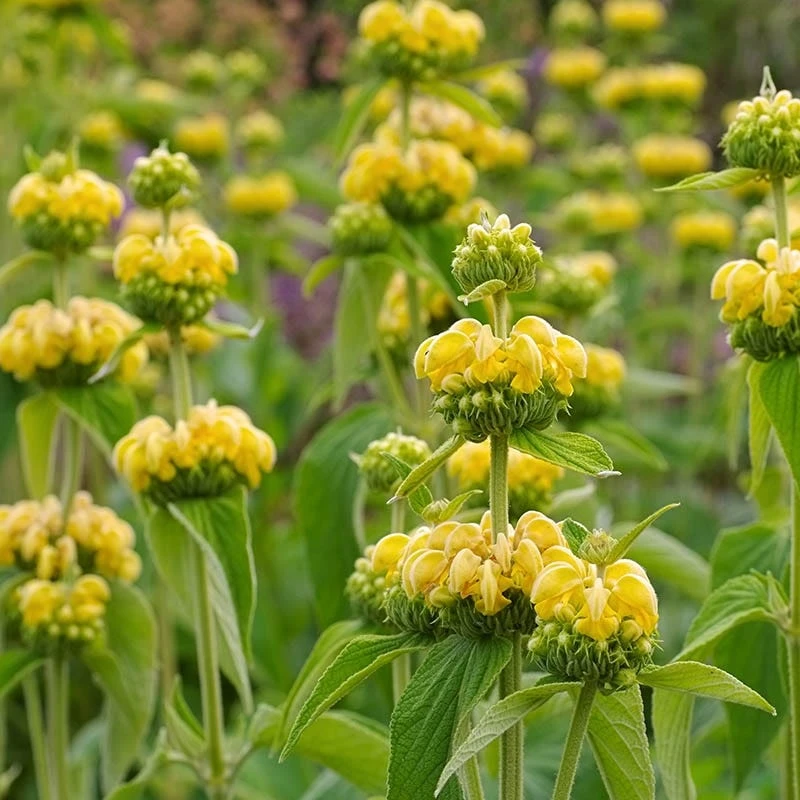
The Xeric Gardener’s Holy Grail
In water-scarce regions from California to the Mediterranean, drought-resistant perennials often sacrifice visual impact for survival. Not so with Hardy Jerusalem Sage. Its architectural presence—36″ tall candelabras of buttery yellow flowers hovering above olive-green foliage—creates instant focal points while requiring 60% less water than traditional flowering shrubs. The secret lies in its Syrian mountain heritage, where evolutionary pressures forged a plant that stores moisture in thick leaves and blooms spectacularly even in poor soils.
Three-Tiered Excellence: Why Phlomis Outperforms
1. Physical Architecture
- Whorled Flower Stacks: 5-7 tiered bloom clusters maximize pollinator access while minimizing water loss
- Felted Leaves: Olive-green foliage with tiny hairs reflects sunlight and traps atmospheric moisture
- Rhizomatic Roots: Underground network seeks deep water reserves unavailable to shallow-rooted plants
2. Performance Comparison
| Feature | Hardy Jerusalem Sage | Lavender | Santolina |
|---|---|---|---|
| Water Needs | Low (xeric) | Moderate | Low |
| Bloom Duration | 8-10 weeks | 4-6 weeks | 2-3 weeks |
| Winter Interest | Seed heads persist | Dormant | Semi-evergreen |
From Struggle to Sanctuary: A Gardener’s Transformation
Initial State
Sarah’s Austin, TX garden was a water-guzzling liability—hydrangeas requiring daily irrigation, lawn turning brown by June, and endless cycles of replacing heat-stressed plants.
The Turning Point
When municipal water restrictions limited outdoor use to one day weekly, her traditional garden collapsed. Research led her to Mediterranean drought-tolerant plants, where Phlomis stood out for its unique combination of visual impact and resilience.
The Solution
Planting Hardy Jerusalem Sage as anchor points created an entirely new aesthetic—structural winter interest from persistent seed heads, summer blooms attracting hummingbirds, and foliage that complemented silvery Artemisia and purple Salvias.
“After three years, my Phlomis specimens have survived both record heat waves and unexpected frosts. They’re the only plants neighbors stop to ask about—that architectural form makes my garden look designed rather than just surviving.”
— Michael R., Denver, CO (Zone 5b)
Why Hardy Jerusalem Sage Earns Its Place
For gardeners seeking low-maintenance perennials that deliver four-season structure, pollinator support, and water-wise performance, Phlomis russeliana represents an ecological and aesthetic breakthrough. Its drought-tolerant landscaping credentials outperform common alternatives like Lavender or Russian Sage in bloom duration and winter presence. At just $8.40 per plant—a fraction of the cost of equivalent architectural shrubs—it offers exceptional value for creating Mediterranean garden ambiance anywhere.