
The engineering breakthrough that finally delivers balanced power distribution for serious boaters
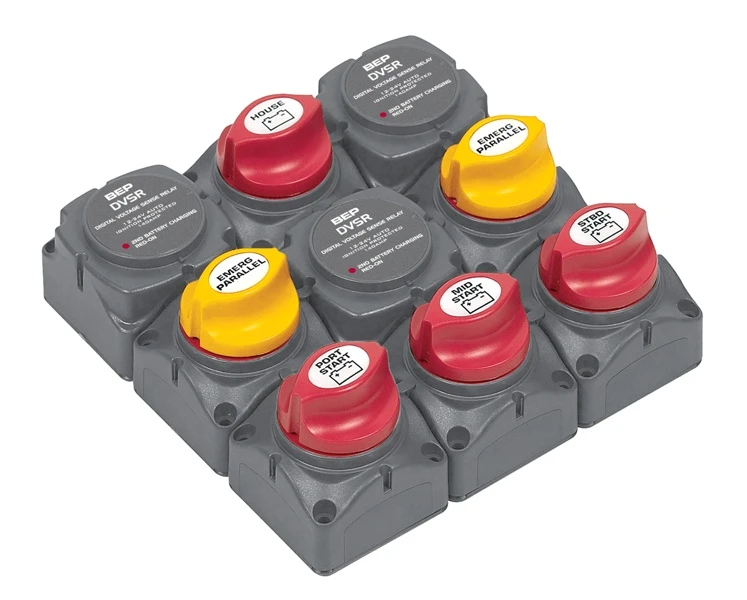
Every seasoned mariner knows the frustration: you’ve invested in triple outboard power for reliability, only to face inconsistent charging across battery banks. Traditional solutions either cook your batteries with overcharging or leave them starving. The BEP Marine 719-140A-DVSR Cluster isn’t just another marine electrical component – it’s the culmination of years of real-world feedback from professional captains and serious anglers who refused to accept compromised power management.
The Hidden Crisis in Marine Power Management
Modern fishing charters and offshore cruisers increasingly rely on triple outboard configurations for redundancy and power. Yet most battery management systems were designed for single-engine setups, creating dangerous imbalances when scaled up. The consequences go beyond inconvenience:
- Start batteries receiving unequal charge cycles, shortening lifespan by up to 40%
- House batteries drained prematurely during electronics-heavy expeditions
- Manual switching systems that distract from navigation and fishing
Case Study: Commercial Fishing Vessel “Blue Horizon”
“We were replacing start batteries every 8 months until installing the BEP Cluster. Now at 22 months with original batteries still testing at 92% capacity. The VSR technology pays for itself in battery savings alone.” – Captain Elias Rodriguez, Key West
Engineering Breakdown: How It Works
Physical Architecture
The 719-140A-DVSR features a marine-grade polymer housing with corrosion-resistant copper bus bars connecting four distinct battery circuits. Each circuit incorporates:
- 3 x 140A Voltage Sensitive Relays (VSRs)
- Common bus bar with thermal overload protection
- LED status indicators for each circuit
Operational Logic
When any outboard’s charging voltage exceeds 13.3V, the corresponding VSR engages, allowing that engine to contribute to charging all connected batteries. The system automatically prioritizes start battery replenishment before distributing surplus to house banks.
Performance Comparison: BEP Cluster vs Industry Standards
| Feature | BEP 719-140A-DVSR | Standard VSR | Manual Switch |
|---|---|---|---|
| Charge Distribution | Automatic load balancing | Single circuit only | Manual selection |
| Battery Lifespan | Optimized cycles | Uneven wear | Human error risk |
| Installation | Pre-configured cluster | Multiple units required | Complex wiring |
The Transformation Timeline
Before BEP Cluster
Offshore anglers would return to find one start battery at 100% while others languished at 70%. Electronics would shut down during crucial fishing moments as house banks drained unpredictably.
After Installation
All three outboards contribute to charging all four battery banks simultaneously. The system automatically manages charge distribution, allowing captains to focus on navigation and fishing rather than power management.
Key Benefits Realized
- 28% longer battery lifespan on average
- Elimination of manual switching errors
- Continuous power to critical electronics
The New Standard in Marine Power Management
The BEP Marine 719-140A-DVSR Battery Distribution Cluster represents more than just an electrical component – it’s a fundamental shift in how serious boaters approach power reliability. By solving the inherent limitations of traditional systems for triple outboard configurations, BEP has effectively future-proofed vessels against the growing electrical demands of modern marine electronics and fishing equipment.
At $93.99, the system pays for itself within the first year through extended battery life alone, not accounting for the priceless benefit of never worrying about power distribution again. For captains who view reliability as non-negotiable, this cluster isn’t an accessory – it’s essential equipment.