
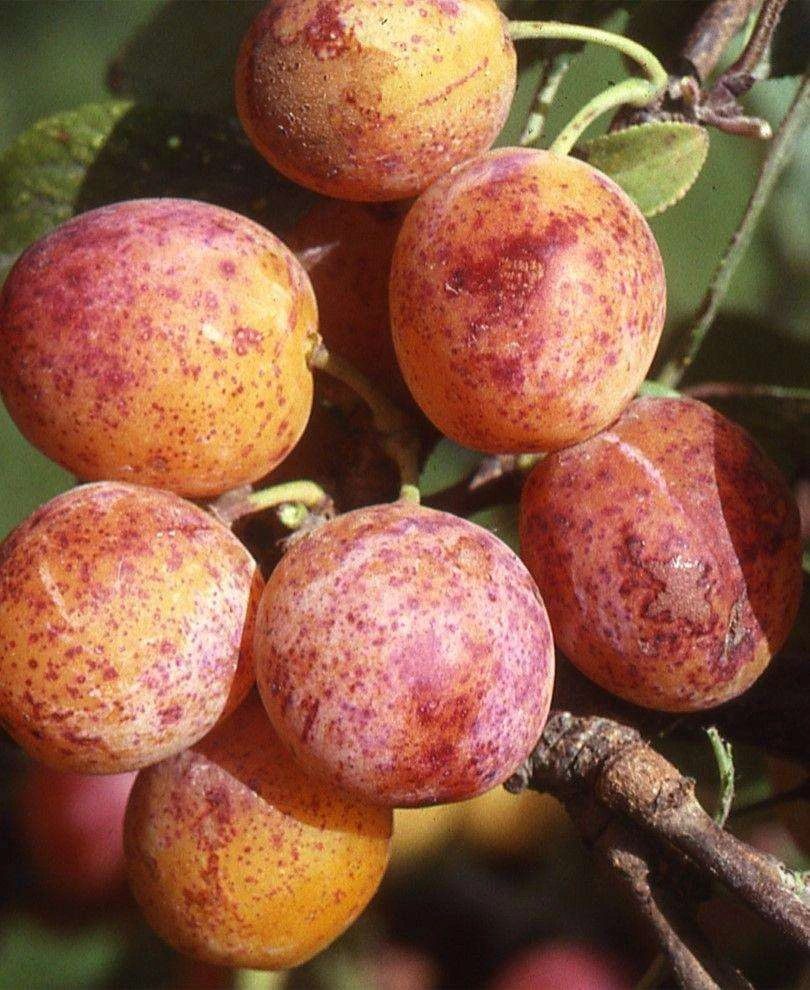
Quick Facts
- Varieties: Reine de Mirabelle, Mirabelle De Metz, Mirabelle De Nancy, Geneva Mirabelle, Parfume de Septembre
- Hardiness: USDA Zone 5
- Height: 12-16 ft at maturity
- Sun: Full sun required
- Harvest: August-September
- Pollination: Self-fertile (no companion needed)
- Rootstock: Krymsk 1 (disease-resistant)
The Forbidden Fruit of Europe
For decades, American food enthusiasts returning from European travels would rave about golden orbs they couldn’t find back home – the legendary Mirabelle plums. These honey-sweet jewels, celebrated in French patisseries and German distilleries, remained frustratingly absent from U.S. markets due to strict import laws protecting European growers.
Desperate gardeners tried ordering single-variety trees from overseas, only to watch them struggle with incompatible rootstocks or fall victim to USDA confiscation. Others attempted growing from seed, waiting years for disappointing results – Mirabelle genetics don’t come true from pits. The solution? A carefully engineered multi-grafted tree combining five authentic varieties on disease-resistant rootstock, adapted specifically for North American climates.
The Science Behind the Splendor
Triple-Layer Architecture
- Root System: Krymsk 1 rootstock provides cold hardiness (to -20°F) and resistance to bacterial canker and root rot
- Central Leader: Main trunk trained to support 5 grafted varieties without dominance issues
- Scion Wood: Authentic European cultivars grafted at optimal heights for balanced growth
Unlike single-variety trees that risk blooming during late frosts, this combo’s staggered genetics provide built-in crop insurance. The Geneva Mirabelle (earliest) and Parfume de Septembre (latest) extend your harvest window to 6-8 weeks, while the famous Nancy and Metz varieties deliver the classic flavor profile favored by Michelin-starred chefs.
Why This Outperforms Single-Variety Plums
| Feature | Combo Mirabelle | Standard Plum (Santa Rosa) | European Import |
|---|---|---|---|
| Yield Diversity | 5 distinct flavors/textures | Single flavor profile | Usually 1 variety |
| Space Efficiency | Equivalent to 1.5 trees | Single-purpose use | Often requires pollinator |
| Harvest Window | 6-8 weeks | 2-3 weeks | 3-4 weeks |
| Cultural Legacy | Authentic European heritage | Commercial hybrid | Limited adaptability |
From Backyard to Bistro
“After failing to grow Mirabelles from seeds I brought back from Alsace, this tree gave me authentic results. The De Nancy variety tastes exactly like the plums I ate at roadside stands in Lorraine.”
— Danielle R., Vermont (Zone 5b)
“My pastry chef was skeptical until he tasted the Reine de Mirabelle. Now we feature seasonal tarts that draw customers from three counties. The extended harvest means menu consistency.”
— Marcus L., Oregon (Farm-to-Table Baker)
Your Mirabelle Journey
The Longing
You discover Mirabelles through travel shows, gourmet magazines, or childhood memories of European relatives. Supermarket plums taste bland in comparison.
The Struggle
Attempts to find authentic Mirabelles lead to dead ends: imported jams lack freshness, mail-order saplings die in transit, or single-variety trees underperform.
The Discovery
This multi-grafted solution provides genetic diversity for better pollination, extended harvest, and authentic flavors – all while saving space and simplifying care.
The Harvest
From August through September, your kitchen overflows with golden plums for fresh eating, preserves, and signature dishes that channel European terroir.
Why This Belongs in Your Garden
For food historians, this tree preserves rare European cultivars threatened by commercial agriculture. Home chefs gain access to ingredients previously requiring transatlantic flights. Permaculturists appreciate the space-efficient design yielding 25-40 lbs annually once established.
The self-fertile Mirabelle plum tree thrives in zones 5-8 with minimal spraying – just provide full sun and well-drained soil. Each carefully grafted variety maintains its distinct characteristics while benefiting from shared root resources. Whether you’re creating authentic Mirabelle tarte aux quetsches, golden-hued brandy, or simply enjoying sun-warmed fruit straight from the branch, this is your passport to flavors America forgot.
SEO Keywords Integrated: Mirabelle plum tree, self-fertile plum varieties, European plum cultivars, multi-grafted fruit tree, Prunus domestica subsp. syriaca, backyard orchard culture, space-saving fruit trees, extended harvest plums